ChatGPT ads for restaurants: what's real, what it costs, how to run them.
Yes, restaurants can advertise inside ChatGPT now. No, that doesn't mean every restaurant should. Since May 2026, you can buy without a six-figure commitment. Here is what is real, what the early numbers look like, and how to test without becoming the ad everyone resents.
What's live in ChatGPT ads (as of August 2026)
These ads are new and changing fast, so every claim below carries its date. As of August 2026:
Ads exist in ChatGPT. OpenAI began testing sponsored placements in February 2026. They show to people on the Free and Go tiers; paid Plus and Pro subscribers do not see them.
Small businesses can buy them now. The pilot launched with a six-figure minimum commitment for large advertisers. In May 2026 OpenAI opened a self-serve Ads Manager to US businesses, and that minimum is gone. Coverage puts practical starting budgets around $20 to $50 a day.
There are two ways to pay. You can pay when someone clicks, or pay for every one thousand times the ad is shown. Reported early pricing is roughly $3 to $5 each time someone clicks and $25 to $60 for one thousand views. These are figures reported by the industry, not prices published by OpenAI, and they will move as more advertisers arrive.
The scale is real. OpenAI reported its US ads pilot passed $100 million in annualized revenue within six weeks, with hundreds of advertisers on board by spring. Expansion beyond the US (UK, Mexico, Brazil, Japan, South Korea) was announced for 2026.
The tools are young. Early advertisers say ChatGPT gives them fewer ways to control who sees an ad, compare versions, and see what happened than Google Ads or Meta. That is normal for something new. It is also a real cost: you will know less about what your money did.
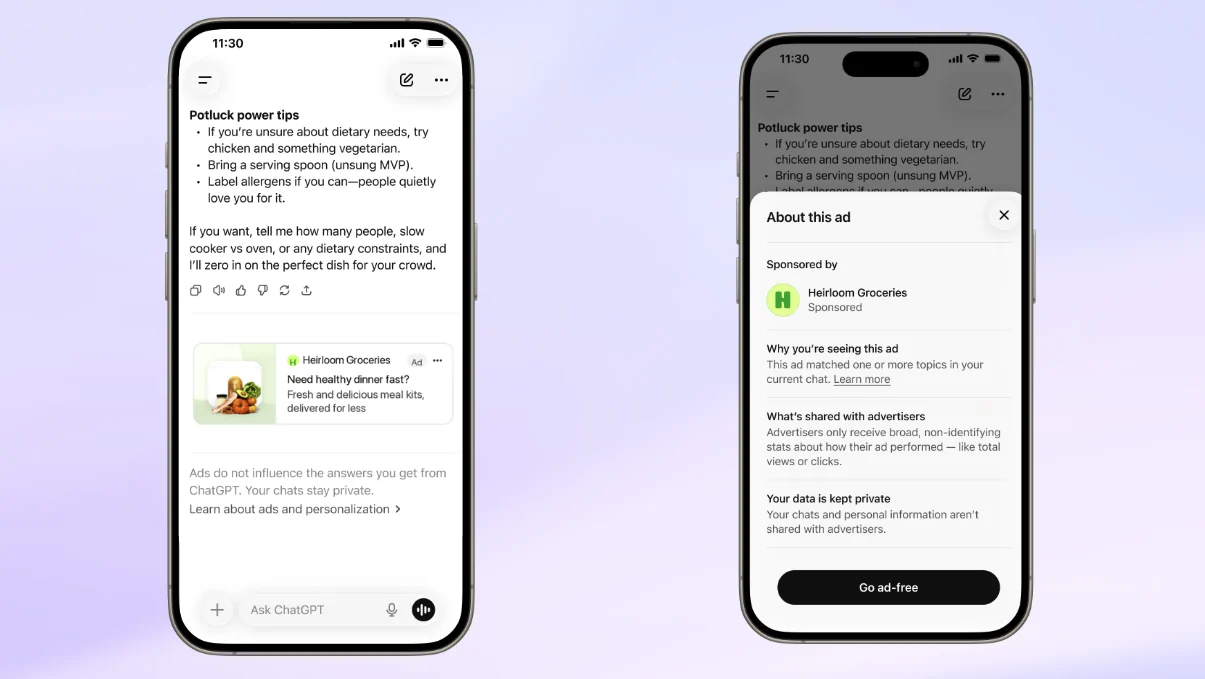
The sponsored block sits below the answer, carries an Ad label, and ships with a disclosure that ads do not influence the answer. Image: OpenAI.
What a small daily budget actually buys
Here is the napkin math. At $30 a day and $4 a click, a month of testing is about $900 for roughly 225 clicks from people asking where to book dinner or host a party. If 1 in 20 clicks becomes a reservation, that is about 11 reservations at roughly $80 each. Does that beat your current Google and Maps ads? We don't know. That is the whole point of the test. Nobody knows yet how many ChatGPT clicks will become reservations, so start small and count the bookings instead of shifting the whole budget.
Two things make restaurants a better fit for these ads than most businesses. Dining questions are among the most natural things people ask an assistant, and the answer is local, so a small restaurant is not always fighting a national brand for the same space.
Key takeaway: Spend enough to learn something. Don't spend enough to regret it.
Only advertise answers diners already ask for
Let's be honest about the room. When ads appeared in ChatGPT, plenty of users were loudly unhappy, and OpenAI has already walked back experiments that made organic suggestions look like ads. People trust an assistant differently than a search results page. An ad that genuinely helps with a dining question can earn attention. An ad that feels like an ambush burns goodwill fast.
My rule: advertise the things people are already asking for. A private dining ad beside party-planning questions can be useful. A generic brand ad interrupting a homework question is noise. Nobody asked the maître d' to follow them into algebra class.
Skip ChatGPT ads until Google and tracking are solid
I'm not going to tell every restaurant owner to spend here. Skip it for now if you cannot tell whether a website click became a reservation or inquiry. Skip it if Google Search and Maps are not already bringing in reservations at a cost you know works, because the money works harder there. And skip it if your total monthly ad budget is under about $1,500, because a readable test should not starve what already works.
And if your goal is to show up in ChatGPT's actual recommendations rather than the ad slot, that is not bought at all. It is earned with consistent data and quotable pages, which is a different project. We wrote up how that works in how restaurants show up in AI search.
How we test ChatGPT ads for restaurants
I'm onboarding ChatGPT ads for restaurant clients as small tests that pay for clicks, use budgets in the $20 to $50 a day range, and focus on private events and reservations where one booking has a known value. Every click should lead to an inquiry or reservation we can actually see, in an account the restaurant owns. I show the math and call a decline a decline. When we have real restaurant results worth sharing, we will publish them here with dates.
Yes. As of mid-2026, OpenAI's self-serve Ads Manager is open to US businesses with no six-figure commitment. Ads show to people on the Free and Go tiers, and coverage puts practical starting budgets around $20 to $50 a day, which puts the ads within reach of an independent restaurant for the first time.
How much do ChatGPT ads cost for a restaurant?
As of August 2026, reported figures vary because the ads are new: roughly $3 to $5 each time someone clicks and $25 to $60 for one thousand views, with tests starting around $20 to $50 a day. At $4 a click and $30 a day, that is 7 to 8 clicks a day. Whether it beats Google or Meta depends on how many clicks become reservations. That is the number the first test needs to answer.
Are ChatGPT ads worth it for restaurants yet?
They are unproven but worth a small test for the right restaurant. ChatGPT gives advertisers fewer ways to steer the ads and less detail about what happened than Google or Meta, and there is no restaurant track record yet. The case for testing now is that prices tend to be lower before competitors arrive. Jay Street treats it as a small test tied to reservations and event inquiries, not a budget shift.
Do ads change ChatGPT's restaurant recommendations?
OpenAI says ads are separate from the assistant's answers, and answer content is not for sale. Showing up in the unpaid recommendations takes clear, consistent restaurant information, useful pages the assistant can quote, and accurate mentions on trusted sites. Buying an ad does not buy the recommendation.
Published by research@jaystmedia.com. We are testing these ads with restaurant clients now, using small budgets. Nothing here is a promise of results, and we say plainly above who should not spend yet.
Published August 4, 2026 · facts checked at publish