Ads may show with Google's AI Overviews. You don't buy that slot.
As of August 2026, Google says ads from the Search and Shopping campaigns you already run can be eligible to appear with AI Overviews. That is not a separate product, and eligibility is not the same as your restaurant ads showing there. Coverage is limited by the query, the language, the market, the campaign type, and Google's systems. Keep Search and Maps healthy. Do not invent an Overview campaign. Getting named inside the answer is a separate, earned problem.
What Google has confirmed about AI Overview ads
As of August 2026, per Google Ads documentation:
Your existing campaigns are the inventory, when Google selects them. Text, Shopping, local, and app ads from Search, Shopping, Performance Max, and App campaigns can be eligible to show above or below AI Overviews in all 200+ markets where Overviews run. Text and Shopping ads from Search, Shopping, and Performance Max can also appear within the Overview itself, currently in English on mobile and desktop in 12 countries including the US. Many restaurants will not see those placements.
You cannot aim at it. Google states you cannot directly target AI Overview placements.
You cannot avoid it. Google states you cannot opt out of serving ads in AI Overviews.
Serving is doubly matched. Both the user's query and the content of the AI Overview are considered, commercial intent is required, and the ad must be relevant to the Overview's content.
You cannot see it separately. Google currently offers no segmented reporting when ads show within AI Overviews. The clicks blend into normal campaign numbers.
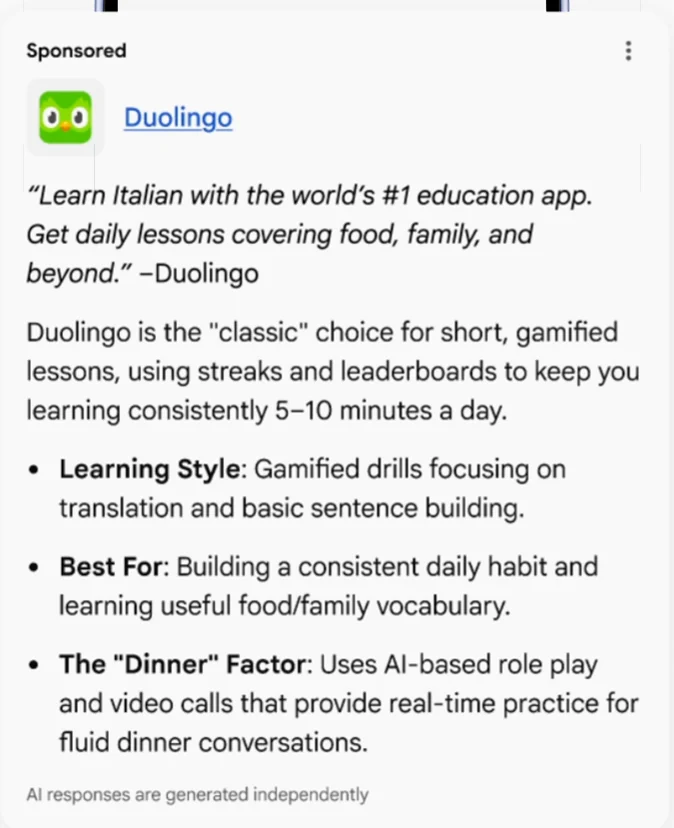
A Sponsored block inside an AI answer in Google Search, from Google's own demo. This frame shows AI Mode; ads that appear with AI Overviews carry the same Sponsored labeling and come from campaigns you already run, when Google selects them. Image: Google.
Ads can appear with Overviews. You cannot buy that slot alone
Put those facts together and the situation is unusual: a placement you cannot buy, cannot refuse, and cannot measure on its own. For a restaurant that means the right response is not a new line item, because there is nothing to buy, and not a claim that your ads are already showing there. Eligibility is not the same as placement. Many restaurants will not see Overview ads. The work is discipline on the things you do control: Search, Maps, and clean tracking.
The doubly-matched serving logic rewards specificity. An account with clean, separate coverage of private dining intent, reservation intent, and neighborhood searches gives the system more real hooks to match against an AI answer than three generic keywords ever will. That is the same search-term discipline that separates a working restaurant account from a wasteful one on the classic results page; the AI surface just raises the price of sloppiness.
And because the platform will not show you the AI slice, your measurement has to live where it always should have: reservations, calls, and event inquiries per dollar, tracked in an account you own. If those numbers are clean, it does not much matter which surface the click crossed.
Ads may ride along automatically. Citations you earn
One distinction worth keeping sharp: ad eligibility around an AI Overview is automatic, but your restaurant being named inside the answer is earned. Overviews cite sources like every other engine, from consistent business data, structured pages, and mentions on sites they trust. A restaurant can be eligible for the ad slot and lose the recommendation, or the reverse. The strong position is both, and the earned half is the same citation work that covers the ad-free engines too. The mechanics are in how restaurants show up in AI search.
Not as a separate product. Ads from existing Search and Shopping campaigns can be eligible to show above, below, and in some markets within AI Overviews. You cannot directly target the placement, and you cannot opt out of it. Eligibility is not a guarantee your ads are showing. There is nothing extra to buy.
How do ads get chosen for AI Overviews?
Per Google, both the user's query and the Overview's content are considered, commercial intent is required, and the ad must be relevant to the Overview. That rewards campaigns with specific, clean coverage of real dining intent over a handful of generic keywords.
Can you measure ad performance inside AI Overviews?
Not separately, as of August 2026: Google offers no segmented reporting for ads within AI Overviews, so those clicks blend into normal results. The practical response is judging campaigns on reservations, calls, and event inquiries per dollar, which is how they should be judged anyway.
What should restaurants change because of AI Overviews?
Keep campaigns tightly matched to real intent, keep the reservation tracking clean, and work the organic citation side, since Overviews cite sources like every other engine. An independent agency such as Jay Street Media reads the actual search terms monthly, and that discipline is what the AI-flavored queries reward.
Published by research@jaystmedia.com, which manages Google Search and Maps campaigns for restaurants and hotels every day. Everything above is sourced to Google's own ads documentation as of August 2026, with the gaps in that documentation called out plainly.
Published August 24, 2026 · framing updated September 9, 2026