Sample Bistro
A local result in the answer
OpenAI launched Businesses in ChatGPT in beta on November 10, 2026. These are the 10 things restaurants, hotels, and hospitality groups need to know before anyone claims a profile. Claiming does not guarantee more recommendations. Checked November 11, 2026.
The 10 things at a glance
Business Hub is the dashboard at chatgpt.com/business-hub, also opened from the ChatGPT sidebar. Insights are 28-day totals. They appear only after the claim is approved and Persona approves identity verification. A Business Agent is a separate chat for eligible ecommerce and online service businesses in the United States that have a website.
ChatGPT can already name a restaurant without a claimed profile. On eligible consumer plans it can also show reservation times from OpenTable, Resy, or Yelp. That search is separate from Business Hub.
You can claim a business if you own it or you are authorized to represent it. You do not need an Ads account or a ChatGPT Enterprise agreement.
Three official lines sit side by side. The launch post says any eligible business where ChatGPT is available can claim. The product page says claiming is initially available to eligible businesses with a website. The Help Center says local stores and restaurants can currently claim only an existing U.S. listing. For a restaurant, use the Help Center line.
A missing local restaurant cannot be added through that article. An eligible online business, such as a merch or gift shop, may see an option to add one. Whether online ordering or a booking site makes a restaurant or hotel an online business is unverified. Hotels, bars, and event venues are not named in the restaurant sentence, so eligibility for them as a class is unverified. Search Business Hub. OpenAI may decline a request or hold a category back.
| Situation | Claim today? | Verification | After Persona | Watch-outs |
|---|---|---|---|---|
| U.S. restaurant or local store with an existing listing | Yes, if you own it or you are authorized to represent it, and ChatGPT already lists it in the U.S. | The method the listing shows: phone, email, DNS TXT, or Shopify. Then Persona. | Publish reviewed edits and open insights. An agent only if eligible. | The blue check follows Persona, not the claim alone. |
| U.S. restaurant not found in Business Hub | No local path to add the missing listing. | None described. | Not available. | A missing restaurant is not documented as the online add-a-business case. |
| Eligible online business, such as a merch or gift shop | Maybe, if an add option appears and verification is supported. | Method shown, then Persona. A new profile publishes on approval. | Update details. Connect a product feed if you sell products. | Needs a website. Location and type still apply. |
| Hotel, bar, or event venue | Unverified as a class. Search the Hub. | Whatever the listing shows, if one exists. | The same tools, if Persona passes. | Official docs do not name these as a class. |
| Multi-unit group or parent brand | Each brand is separate. The parent claim does not claim locations. | One path per listing. A managed path may exist for Enterprise or advertiser accounts. | Teammates and agency access, each on their own account. | No central management. Managed-claim locations stay locked by default. |
| Business outside the U.S. | Not on the existing U.S. listing path. Depends on location and type. | Only if the Hub offers a method. | Only after approval and Persona. | The launch post still sits under the Help Center limit for local restaurants. |
Sign in, open Business Hub, and search by name. Select the listing and confirm the ChatGPT account that will manage it. Use an account the business will still control if a manager leaves.
Verify with the method shown. Phone or email sends a code. A domain check uses the exact DNS TXT record. Shopify uses Connect Shopify. OpenAI emails a decision. You can cancel while the claim is under review.
Then finish Persona. The blue check appears only after that approval, and you need it before edits publish or insights open. If the screen says Contact support, the listing is locked. Do not forward a personal claim invitation. Edits must follow the Businesses in ChatGPT policy: accurate hours and contact details, with no fabricated reviews.
A mention is a different count for a local business and for an online business. For a local business, OpenAI counts a mention when ChatGPT shows a result for that location, even if nobody opens the listing or the site. For an online business, a mention counts only when ChatGPT references the website. The brand name alone does not count. Do not add those two numbers together.
A website click is a click through to the site. OpenAI does not define it as a visit or a booking. Discovery topics are themes in answers that mentioned or cited the business. They are not individual prompts.
Insights cover the past 28 days and appear only above a threshold OpenAI does not publish. A blank cell can mean the threshold was not met, data is still collecting, or reporting is unavailable. It does not necessarily mean zero. Businesses do not receive the prompts. The docs checked November 11, 2026 do not describe an export. TechCrunch listed profile views on November 10. The Help Center list does not, so this note does not treat views as official. Which mention row applies to a hotel is unverified. The table keeps both definitions apart. The cells are illustrations, not counts from a venue.
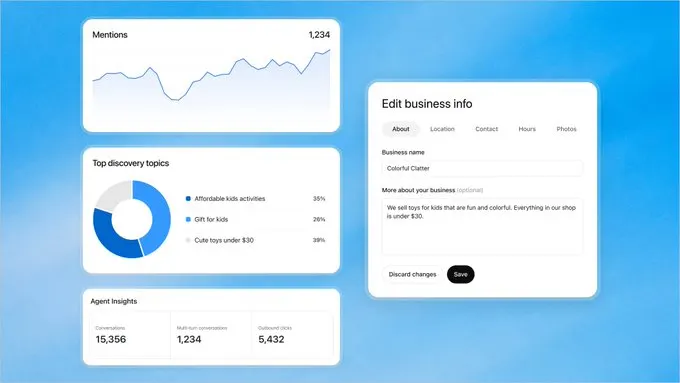
That Insights image shows mentions and topics. It does not show a reservation. A booking that continues at OpenTable, Resy, or Yelp is a separate path.
Illustration, not a screenshot
ChatGPT
A table for two nearby tonight
Sample Bistro
A local result in the answer
The card above counts with no click.
An arrow from that answer to the restaurant site. A Hub click, not a visit or a reservation.
An arrow onward to OpenTable, Resy, or Yelp. Not a Hub metric.
| Metric | What OpenAI counts | Restaurant | Hotel | Does not tell you |
|---|---|---|---|---|
| Mentions, if treated as a local business | A shown location result, even with no click. | A location card can count when the diner never opens it. | Same rule if the hotel is treated as local. Unverified. | Not a visit, a cover, or a room night. |
| Mentions, if treated as an online business | A reference to the website. The name alone does not count. | A merch or gift site counts only when the website is referenced. | Same rule if the hotel is counted as online. Unverified. | A name with no website reference. |
| Website clicks | Clicks through to the website. | A click to the restaurant site. | A click to the hotel site. | Not defined as a visit or a booking. OpenTable, Resy, and Yelp completions are separate. |
| Discovery topics | Themes in answers that mentioned or cited the business. | OpenAI's grouping. No sample themes here. | The same grouping. | Not prompts, and not a direct read of intent. |
| 28-day window and blank values | 28-day aggregates, above an unpublished threshold. | A blank can mean under the threshold, still collecting, or reporting off. | Same three reasons. | A blank is not automatically zero. No export in the docs reviewed. |
Business Hub does not replace a Google Business Profile, a menu, or a private-dining page. ChatGPT may still use other sources. The comparison is an operator's reading. Official docs checked here do not name Google Business Profile as a Hub source. A prompt list is questions you ask and save. Business Hub does not provide those prompts.
| Job | Business Hub | Google Business Profile | A prompt list you keep |
|---|---|---|---|
| Who can edit | The approved claimant, after Persona. OpenAI reviews changes. | Whoever holds the Google profile. Keep hours consistent with what you send OpenAI. | Whoever runs the list. |
| Where it is used | The ChatGPT profile. ChatGPT may also use other sources. | Google Search and Maps. Not named as a Hub source. | The questions you choose. |
| What a mention or a view means | Local: a shown location. Online: a website reference. Views are not in the Help Center list. | Google's own reporting. Not a Hub number. | A saved answer is a Hub mention only if it matches OpenAI's count. |
| Booking | Not a Hub metric. | A booking link there is not a Hub click. | A reservation prompt is not a completed booking. |
| Competitors | Not described. | Not a report of another venue's ChatGPT mentions. | You can save the same questions about other venues. |
| Time window | Past 28 days. No prompts. No published threshold. No export in the docs reviewed. | Google's own range. Not a ChatGPT transcript. | The dates and questions you save. |
How a restaurant already shows up in AI answers is covered in how restaurants show up in AI search. The Google profile work that still sits beside Business Hub is in restaurant Google Business Profile and local SEO.
A claimed profile is not the only description ChatGPT can use. Profiles may also include information from other sources. ChatGPT may use an approximate IP location for local results, including restaurants. Device location is optional and off by default. Nearby listings come from unnamed trusted providers. Microsoft and Shopify are the named search partners.
Reservation search can show times from OpenTable, Resy, or Yelp on eligible consumer plans with GPT-5.6 Sol or GPT-5.6 Luna. OpenTable is global, Resy is the United States, and Yelp is the United States and Canada. It is not available on Business, Enterprise, or Edu plans, or in ChatGPT Work. ChatGPT does not save an existing reservation. A live hotel-rate feed is not described in the pages checked on November 11, 2026.
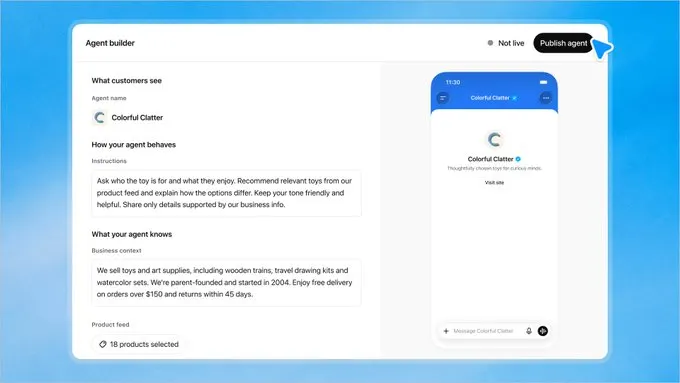
The current agent cannot complete a purchase, a reservation, or a hotel booking. It links to the website instead. Only a published agent can be chatted with, separate from ChatGPT's own answers. Whether a booking site makes a restaurant or hotel eligible is unverified. A sponsored agent used for ChatGPT ads is labeled separately. Shopify is not required.
These steps apply the official rules to one venue and to a group.
| Action | One restaurant or hotel | Multi-unit group |
|---|---|---|
| Search Business Hub for each listing | A U.S. restaurant needs an existing U.S. listing. A hotel, bar, or venue should look. That class is unverified. | Search each brand and location. The parent claim does not cover them. |
| Claim, then Persona | Use a durable business account. Persona comes before published edits and insights. | Same on each profile. Do not forward a personal invitation. |
| Update facts you can stand behind | Hours, description, category, website, and logo. OpenAI reviews them. | Same standard at every location. ChatGPT may still use other sources. |
| Keep the other pages consistent | Match the website, menu, private-dining page, and Google profile to what you submit. | Do that per venue. A group page does not replace the room or hotel page. |
| Record Insights weekly | No export is described. Write down mentions, clicks, topics, and blanks. | One sheet per location. Do not add a local mention to an online mention. |
| Read clicks beside referrals | A Hub click is OpenAI's count. A chatgpt.com referral is a visit with that source. Neither is a reservation. | Compare per venue before you add the numbers up. |
| Locked profiles | Use Contact support when the listing says it is locked. | Ask the OpenAI contact. Managed-claim locations stay locked by default. |
For the room page, see private dining and buyouts. Groups can also use multi-location restaurant group marketing and the multi-city guide. OpenAI has said it plans tools for more complex organizations, with no date.
ChatGPT Business is a paid workspace plan. Businesses in ChatGPT is a separate beta, launched on November 10, 2026, for claiming a profile in Business Hub. You do not need an Ads account or a ChatGPT Enterprise agreement to claim an eligible business. Ahrefs, checked November 11, 2026, showed 3,500 monthly U.S. searches for chatgpt for business and no keyword row yet for chatgpt business hub.
Yes, if ChatGPT already has a U.S. listing and you own the restaurant or are authorized to represent it. The Help Center says local stores and restaurants can currently claim only an existing U.S. listing. Finish the method shown, then Persona, before edits publish or insights open. A missing local restaurant cannot be added on that path.
The Help Center names local stores and restaurants and does not name hotels, bars, or event venues, so eligibility for those places is unverified. Search Business Hub rather than assuming the restaurant rule applies. OpenAI may hold a category back. The product page says the initial claim is for eligible businesses with a website.
No. The current agent cannot complete a purchase, a booking, or a check of a customer's order. It can explain products and policies and link to the website. OpenTable, Resy, and Yelp reservation search is a different feature. The pages checked on November 11, 2026 do not describe a live hotel-rate connection.
No. A blank metric can mean activity has not reached the reporting threshold, data is still being collected, or reporting is unavailable. It does not necessarily mean zero. Insights cover the past 28 days. OpenAI does not publish the threshold or the individual prompts. If a metric stays blank, contact OpenAI Support.
Tell us which venues already appear when you search Business Hub, and how guests book a table, a room, or a private event today. We can sort what is claimable now from what should stay on the website and the Google profile.
Published by Jay Street Media. Platform details were checked against the sources above on November 11, 2026. This article reports product information and a practical reading for restaurants, hotels, bars, event venues, and multi-unit groups. It does not report a claimed Business Hub listing, and it does not report venue results.
Published November 11, 2026